
Sodium-Ion Battery Technology in EVs: The Next Step in Electric Mobility?
Sodium-ion batteries are emerging as an alternative for electric vehicles, offering potential benefits in cost and raw material availability. Explore their advantages, limitations, and future role in electric mobility.
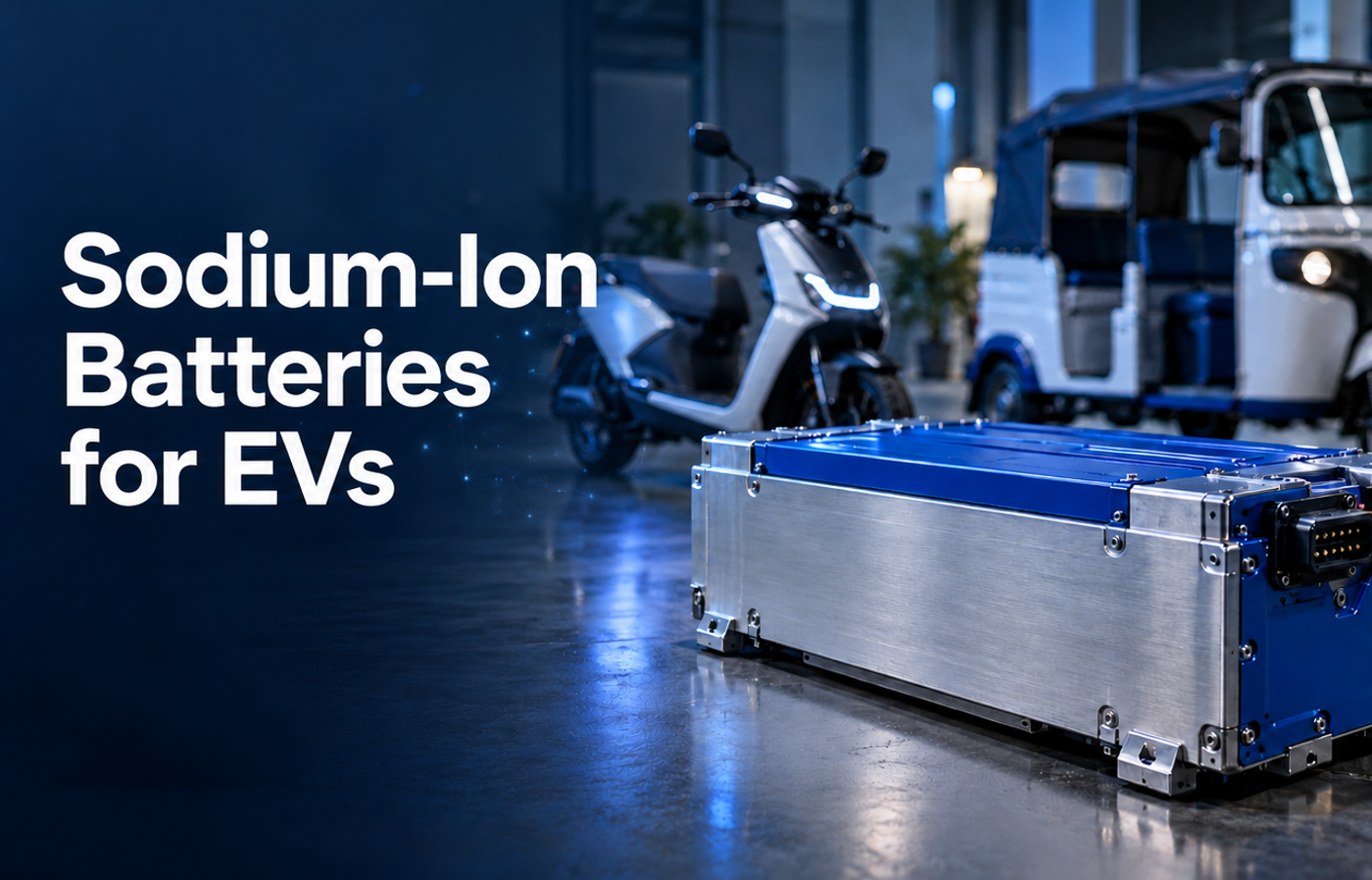
Introduction: What If Electric Vehicles Could Run on Sodium?
Electric mobility is evolving rapidly. From electric scooters and three-wheelers to commercial vehicles, batteries are at the heart of this transformation. Today, lithium-ion batteries power a large part of the EV industry. But researchers and battery manufacturers are exploring another option: sodium-ion battery technology.
The idea is simple but promising. Instead of relying on lithium as the main charge-carrying element, sodium-ion batteries use sodium, a widely available element found in common salts and other natural resources.
Could this make electric vehicles more affordable? Could sodium-ion batteries reduce dependence on lithium? And could they eventually become a practical choice for India's growing EV market?
The answer depends on understanding both the advantages and the limitations of this emerging technology.
1. What Is a Sodium-Ion Battery?
A sodium-ion battery is a rechargeable battery that stores and releases energy by moving sodium ions between two electrodes during charging and discharging. Its basic working principle is similar to that of a lithium-ion battery. The main difference is the ion used to carry the charge: sodium instead of lithium.
During charging, sodium ions move through the electrolyte and are stored in the negative electrode. During discharging, they move back towards the positive electrode, releasing electrical energy that can power an electric motor.
A typical sodium-ion battery contains four key components: Cathode: The positive electrode, made from sodium-containing materials. Anode: The negative electrode, commonly made using hard carbon. Electrolyte: The medium that allows sodium ions to move between the electrodes. Separator: A thin layer that prevents direct contact between the electrodes while allowing ions to pass through.
Although the underlying principle resembles lithium-ion technology, the materials, cell design, voltage, energy density and charging requirements can differ.
2. Key Benefits of Sodium-Ion Batteries
A. Potential for Lower Costs Sodium is widely available, which could help reduce dependence on lithium supply chains. Some sodium-ion chemistries can also reduce reliance on other materials used in certain lithium-ion batteries. With improved manufacturing scale and efficient production, sodium-ion batteries could become cost-competitive in selected applications. However, lower raw material costs do not automatically mean a cheaper battery pack. Manufacturing, cell performance, production volumes, and supply-chain maturity all influence the final price.
B. Greater Raw Material Availability Growing EV adoption is increasing demand for battery materials. Sodium-ion technology offers manufacturers another option to diversify their raw material sources. Depending on the chemistry, it can also reduce dependence on nickel or cobalt. This could help manufacturers manage supply-chain risks, although sodium-ion batteries still require suitable materials, processing, and manufacturing infrastructure.
C. Promising Low-Temperature Performance Certain sodium-ion battery designs show promising performance in cold conditions compared with some lithium-ion alternatives. This can be useful for applications where low-temperature operation is important. However, performance varies by cell design, and usable capacity, charging limits, and power output must be checked against actual specifications. In hot climates such as India, thermal performance and operating temperature limits are equally important.
D. Potential for Energy Storage Sodium-ion batteries may be suitable for stationary energy storage, including solar energy systems and grid-support applications. In these systems, battery weight may be less critical than cost, safety, lifespan, and available storage capacity. This creates opportunities for sodium-ion technology as manufacturing develops.
3. Limitations of Sodium-Ion Batteries
A. Lower Energy Density Many current sodium-ion cells have lower energy density than leading lithium-ion EV cells. Energy density determines how much energy a battery can store relative to its weight or volume. When energy density is lower, a battery may need more space or weight to store the same amount of energy. For electric two-wheelers and three-wheelers, this can affect vehicle weight, available storage space, payload, and driving range.
B. Range and Packaging Challenges EV manufacturers must balance battery capacity, vehicle size, weight, and performance. A sodium-ion battery may be suitable for vehicles with shorter daily routes or designs that can accommodate a larger battery. However, applications requiring maximum range from a compact, lightweight pack may favour higher-energy-density alternatives. The right choice depends on actual driving requirements rather than battery chemistry alone.
C. Developing Commercial Ecosystem Lithium-ion technology benefits from established manufacturing facilities, mature supply chains, and widespread use in electric vehicles. Sodium-ion technology is still developing commercially, with availability and maturity varying across manufacturers and markets. Before adopting it, businesses should evaluate supplier reliability, product availability, quality control, service support, and verified performance data.
D. Charging and Compatibility Sodium-ion batteries cannot automatically replace lithium-ion batteries in existing EVs. Different chemistries may have different voltage ranges, charging requirements, and operating limits. The battery management system (BMS), charger, motor controller, and other vehicle electronics must be compatible with the selected battery. Charging speed also depends on the specific cell, temperature, charger, and charging strategy.
E. Safety and Durability No rechargeable battery chemistry is completely risk-free. Safety depends on cell design, pack construction, protection systems, and operating conditions. A properly engineered battery should include appropriate electrical protection, temperature monitoring where required, mechanical protection, and validated charging controls. Cycle life and durability must also be verified using reliable test data for the intended application.
4. Can Sodium-Ion Batteries Power Electric Two-Wheelers and Three-Wheelers?
Potentially, yes, provided the battery meets the vehicle's performance requirements. Electric two-wheelers: Lightweight design and compact packaging are important. Sodium-ion batteries could suit selected models where daily range requirements and battery costs align with their capabilities. Electric three-wheelers: Passenger and cargo vehicles often operate on regular routes. Sodium-ion batteries may be worth evaluating where range, payload, charging time, and operating costs meet business needs. Commercial fleets: Fleet operators need to consider more than the initial battery price. Vehicle downtime, charging costs, battery lifespan, maintenance, and replacement costs all affect profitability. In every case, real-world testing and a suitable battery configuration are essential before adoption.
5. What Does the Future Hold?
The future of sodium-ion batteries depends on improvements in energy density, manufacturing efficiency, durability, and commercial availability. As the technology develops, it may become an attractive option for selected EV segments and stationary energy storage applications. However, it is unlikely to replace lithium-ion batteries across every category. High-range, weight-sensitive vehicles may continue to favour higher-energy-density solutions, while other applications may benefit from sodium-ion's material availability and potential cost advantages. The EV industry is moving towards a future where different battery chemistries serve different needs.
Conclusion: Choosing the Right Battery Matters Most
Sodium-ion technology offers promising opportunities through widely available raw materials, potential cost advantages, and performance benefits in certain conditions. At the same time, energy density, vehicle range, compatibility, and commercial maturity remain important considerations. For EV manufacturers, dealers, and fleet operators, the key question is not simply which battery chemistry is better. It is which battery best meets the vehicle's range, weight, charging, safety, durability, and cost requirements.