
How Laser Welding Impacts ESS Battery Safety, Performance and Reliability
Discover how laser welding affects battery connections, electrical performance and long-term reliability in Energy Storage Systems (ESS), and why precision manufacturing matters.
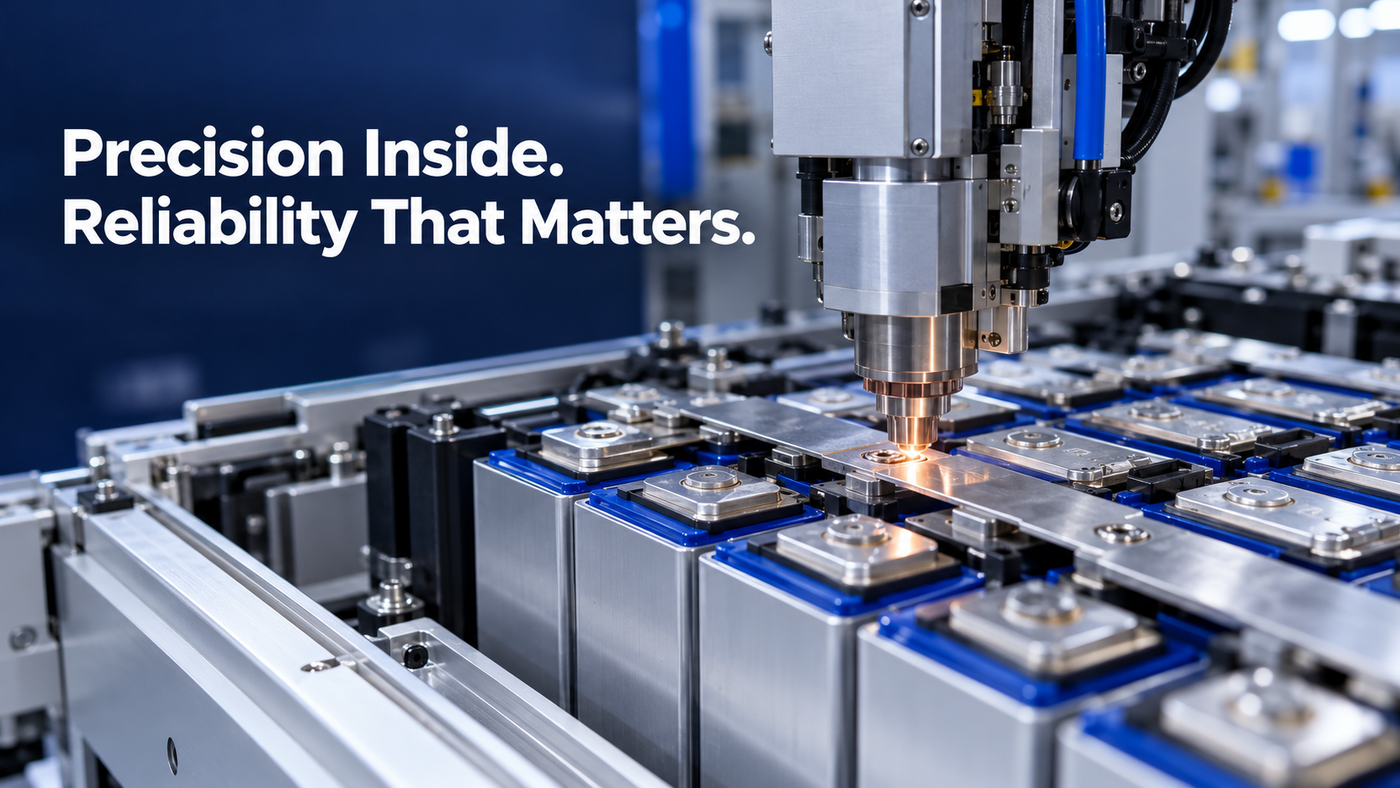
Introduction: An ESS Battery Is Only as Strong as Its Connections
When people talk about Energy Storage Systems (ESS), they usually focus on battery capacity, charging speed, backup duration and battery chemistry. These are important factors, but there is another part of battery manufacturing that deserves equal attention: the quality of the connections inside the battery pack. An ESS battery may contain hundreds or thousands of individual cells, depending on its design. These cells must be connected electrically so that the complete system can store and deliver energy as required. Even when high-quality cells are used, poorly made electrical connections can affect the performance and reliability of the complete battery pack. This is where laser welding becomes important. Laser welding is a precision manufacturing process that uses a concentrated beam of light to join metal components. In battery manufacturing, it can be used to create electrical connections between suitable cell terminals, tabs and busbars, depending on the pack design. But how does this process affect ESS performance? What happens when a weld is not made correctly? And why should buyers look beyond battery specifications when choosing an energy storage solution? Let's understand.
What Is Laser Welding in Battery Manufacturing?
When we think about an Energy Storage System (ESS), we usually think about how much energy it can store, how long it can provide backup, and how efficiently it works. But there is another important factor that often goes unnoticed: how the battery's internal connections are made. Inside a battery pack, individual cells are connected to work together and deliver the required power. These connections carry electricity every time the battery charges or discharges. If they are not made properly, they can affect the battery's performance, reliability and safety. This is where laser welding plays an important role in battery manufacturing.
How Does Laser Welding Affect ESS Performance?
1. Better electrical connections Electricity must flow through the connections between battery cells. If a connection has high electrical resistance, some energy is converted into heat instead of being transferred efficiently. Properly manufactured welds help maintain the intended electrical performance of these connections. This is especially important in ESS applications, where batteries may need to deliver power for extended periods. 2. Better control over heat Heat is a natural part of battery operation, but excessive heat in one small area can become a problem. A poor electrical connection may develop a hotspot when current passes through it. If left undetected, this can damage nearby materials and increase the risk of electrical faults. Laser welding allows heat to be applied precisely during the joining process. With the right settings and inspections, this can help create consistent connections and reduce the chances of manufacturing-related defects. 3. Consistent manufacturing quality An ESS battery may contain many interconnected cells. Each connection needs to meet the requirements of the battery design. Laser welding can support repeatable, controlled production, helping manufacturers maintain consistency across battery packs. This is particularly valuable when producing batteries for commercial energy storage, solar applications and other demanding uses. Of course, the complete battery still needs appropriate testing and protection systems. Welding is one important part of overall battery quality, not the only factor.
What can happen if battery connections are not made properly?
Imagine using a water pipe with a poorly fitted joint. Even if the pipe itself is good, the weak connection can create problems. Battery connections work differently, but the principle is similar: the quality of the connection matters as much as the quality of the components being connected. Poorly made battery joints can lead to increased electrical resistance, unwanted heat, mechanical weakness and inconsistent performance. In serious cases, defects may contribute to electrical or thermal safety risks. That is why battery manufacturers must pay attention to how connections are made and how their quality is checked. A reliable battery depends on several things working together: good cells, properly designed connections, a suitable Battery Management System (BMS), effective thermal management and thorough testing.
Why does this matter in Energy Storage Systems?
ESS batteries are used to store electricity for applications such as solar power, commercial backup and industrial energy management. These systems may charge and discharge repeatedly over their operating life. Their internal connections must therefore be designed to handle the expected current, temperature changes and operating conditions. For buyers, this means that choosing an ESS battery should involve more than comparing voltage, capacity or price. Understanding the manufacturer's approach to engineering and quality control is equally important. The right questions are simple: How are the battery connections made? How is their quality checked? And how is the complete battery pack tested before it is put into use? These details help build confidence in the product beyond its specifications.
Why SPG LiFe uses laser welding
At SPG LiFe, we understand that dependable energy storage begins with careful attention to the details inside the battery. That is why we use laser welding equipment in our in-house battery manufacturing process. Laser welding supports precision joining and manufacturing consistency when the process is correctly designed and controlled. It is one part of our approach to building battery packs with attention to their application and performance requirements. We believe battery manufacturing is not just about assembling cells. It is about understanding how the components work together and making the right engineering decisions at every stage. Because when a battery is expected to deliver dependable power, even the connections inside it matter.